maxim88news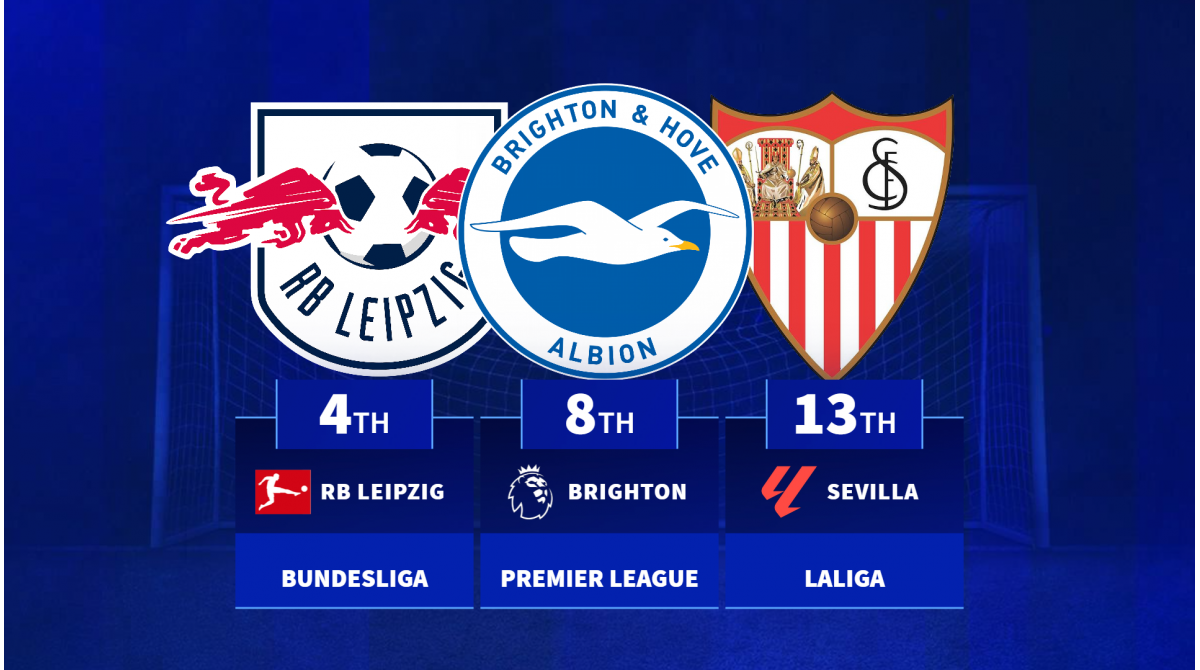
Exclusive TM data dive

©TM/IMAGO
The idea of operating as a selling club is one that’s risen to prominence in European football over the past decade. As clubs receive more TV money to invest in their squads and UEFA’s financial regulations leave certain clubs hamstrung, some struggle to stay afloat in the lucrative top divisions without spending. It has led to some clubs accepting their status as a ‘selling club’, prioritising player sales as their biggest source of income and focusing on a steady stream of signing players at a young age with potential to be sold on for a big profit.
From the top five European leagues, Brighton, RB Leipzig, Atalanta, Sevilla and AS Monaco are the standout clubs to have done this consistently over the past five or 10 years. But how effective is it in securing their survival? In this deep dive, using exclusive Transfermarkt data, we analyse how it has affected their performance on and off the pitch.
Brighton
Over the past five years in the Premier League, Brighton are only second to Chelsea in terms of income from player sales, raking in €665m and spending €674m. Their transfer balance of -€8.2m over that whole period is the smallest of any club to have played in the Premier League for all five of those seasons. Chelsea, however, have spent more than three times as much money on their own transfers.

Brighton made €265m from selling Moisés Caicedo, Marc Cucurella, João Pedro and Robert Sanchez to Chelsea alone. Then there’s the €60m earned for selling Jan Paul van Hecke, €50m taken from Arsenal for Ben White, as well as €42m for Alexis Mac Allister’s transfer to Liverpool. They have a certain je ne sais quois when it comes to offloading players for big fees. Conversely, Georginio Rutter remains Brighton’s record signing at €46.2m and no other player has been signed for bigger fee than that.
They qualified for the UEFA Conference League this season under Fabian Hurzeler which, considering their recent sales, is all the more impressive. The fact they finished above Chelsea, who signed four of their most important players, is another feather in the cap. Brighton have hovered around mid-table but qualified for Europe twice in the last five seasons, highlighting the effectiveness of their model. Their extensive scouting network allows them to repeat the process when they sell a player of Caicedo or Cucurella’s calibre.
They’ve already continued that trend by bringing in Michael Svoboda for just €6m, as well as negotiating a €50m deal with Tottenham for Luka Vuskovic. Based on his performances with HSV in 2025/26, that fee could easily double in a few years’ time. Brighton’s €647m squad value suggests they will be able to continue signing players for modest fees – while flogging their big-name players for exorbitant amounts – for years to come.
RB Leipzig
Remarkably, RB Leipzig have made €749.4m from player sales since the 2021/22 summer transfer window, with their balance sheet showing a €77.1m profit over time. Josko Gvardiol, Benjamin Sesko, Dominik Szoboszlai, Xavi Simons, Dani Olmo, Christopher Nkunku, Loïs Openda, Dayot Upamecano, Ibrahima Konaté were all sold for fees over €40m during that time. Openda and Simons are the only players to be signed for over €40m in Leipzig’s history and they were both moved on for profit.
In fact, you have to go down as far as their seventh-most expensive signing, Castello Lukeba at €30m from Lyon, to find a player still at the club – and speculation persists the 23-year-old will be sold this summer as well. Considering the huge turnover and the profile of the players they have sold, Leipzig have done remarkably well to retain their place as one of the regular qualifiers for the Champions League in the Bundesliga – only failing to do so in 2024/25 when they finished seventh. Their record since 2021/22 reads: 4th, 3rd, 4th and 7th and 3rd, and despite that, they still fired head coach Ole Werner.

With a €549m squad value, Leipzig look set to continue the trend this summer. Yan Diomande and Antonio Nusa are being targeted for big-money moves after impressive World Cup displays, while Lukeba is expected to depart for more than his €50m market value. Diomande could fetch up to €130m if he joins PSG, which would present a record sale, while Nusa may leave for around €60m. But don’t expect them to challenge Bayern Munich or even Borussia Dortmund unless they dig deep into their pockets again to replace those starlets.
Sevilla
One of the first clubs to base their strategy on sales thanks to the market exploits of their former sporting director Monchi, Sevilla’s sales rank the highest outside of LaLiga’s big three (Real Madrid, Barcelona and Atletico Madrid) with €654.4m since 2016/17. Importantly, their transfer balance over that time is €20.3m. Jules Koundé, Wissam Ben Yedder, Clément Lenglet, Vitolo, Kévin Gameiro, Diego Carlos, Grzegorz Krychowiak, Steven Nzonzi, Bryan Gil, Loïc Badé were all sold for fees over €25m. Yet Sevilla have only ever signed two players for a fee that exceeds that amount – Koundé for €35m from Bordeaux in 2019/20 and Rony Lopes from Lille in the same summer for €25m.
The problem for Sevilla now is that their recruitment model hasn’t worked in recent years – and that’s reflected by their recent league finishes. Their overall squad market value has dropped to €161.1m and without significant or shrewd investment, they are in deep danger of being relegated in 2026/27. With their top-valued players Lucien Agoume and Akor Adams valued at just €15m, there isn’t much potential for boosting their transfer purse by selling players either.

Between 2016/17 and 2021/22, Sevilla finished in the top four in four out of those seven seasons and qualified for Europe in all of them. Since then, they’ve failed to finish inside the top 10 and narrowly avoided relegation in 2024/25, as well as finishing one point above the dropzone last time out. It’s a difficult time, and an attempt from Sergio Ramos’ consortium to complete a takeover ended in failure. Sevilla will hope their academy can produce some more talents like Juanlu Sanchez and Kike Salas to boost their transfer coffers.
Atalanta
The Serie A has been struggling to keep up with other super leagues for some time, but Atalanta have cracked the code. La Dea can boast having €1.02bn sales over the 10-year period between 2016/17 and 2026/27 and not only that, a €230m transfer balance – the highest of any Serie A club over that period.
That has come from buying talent at a reasonable cost and flipping them for enormous profit. Rasmus Højlund, Mateo Retegui, Teun Koopmeiners, Marco Palestra, Cristian Romero, Alessandro Bastoni all left for fees exceeding €40m. That’s without mentioning Dejan Kulusevski, Ademola Lookman, Franck Kessié, Robin Gosens, Amad Diallo and Bryan Cristante all were sold for over €25m too.
Only recently have Atalanta started to reinvest, but with caution. El Bilal Touré, 21, is their club-record signing after arriving from Almería for €30.2m in 2024. Gianlucca Scamacca was signed for a third of what they received for Højlund. Nikola Krstović was less than half what they received for Retegui. It’s hardly earth-shattering business, but it’s effective enough to keep them challenging the likes of Roma, Lazio and Juventus without breaking the bank.
Considering he managed the squad with a shoestring budget, Gian Piero Gasperini did a brilliant job in guiding Atalanta to Champions League football in two out of the last five seasons. It’s no coincidence that their legendary boss left for Roma and the Italian side struggled without him, finishing seventh in 2025/26.
With a €431m squad value, Atalanta remain an attractive destination for buyers. They’ve already sold Palestra to Chelsea for €57m this summer, as well as agreeing to let Ederson join Manchester United for €44m. Giorgio Scalvini and Marco Carnesecchi are targets for clubs across Europe, while teenage wonderkid Honest Ahanor, 18, was signed for €16m last summer from Genoa and has been subject of a €34m bid from Brighton. After missing out on the Champions League, the Bergamo outfit look set for another summer filled with sales without many new faces coming in through the doors.
AS Monaco
Over the last decade, Monaco have spent €866.20m on 241 transfers and remarkably, sold the same number of players for €1.16bn. Not even Ligue 1 rivals PSG (€956.4m) or Lyon (€947.5m) can match that level of sales. It really begs the question just how successful Monaco could’ve been if they kept some of the players they sold. Kylian Mbappé, Aurélien Tchouaméni, Thomas Lemar, Benjamin Mendy, Bernardo Silva, Fabinho, Youri Tielemans, Axel Disasi, Tiemoué Bakayoko all went for €40m or more. During that same period, Monaco only signed one player, Wissam Ben Yedder, for a fee in that region.
Yet looking at their league position over time, Monaco’s standing in Ligue 1 has fluctuated with some concern. They were flying high in 2016/17 after snatching the title off PSG, before selling Silva, Mendy and Bakayoko to clubs in the Premier League. They missed out on the title, and Mbappe, Lemar, Fabinho followed those who left before out the door. Leonardo Jardim’s side were fortunate to escape relegation, and it took them another season to get back on their feet and back into Champions League qualification places.
While their current market value of €363.1m is far from being elite, Monaco are well-placed to sell some big names again this summer. Maghnes Akliouche, with a market value of €50m, is wanted by PSG and English clubs. They could also cash in on World Cup stars Folarin Balogun and Lamine Camara – both valued at €40m. Being out of the Champions League will only increase the pressure on Monaco to sell to make ends meet, as well as unearthing talents to bring in to sell on in the future.
Verdict
The recent plight of Sevilla from Europe to relegation candidates and the disappointing finish from Monaco last season suggest that a cohesive recruitment strategy after selling stars is absolutely key. If clubs decide not to invest the majority of the funds raised, they must consider signing a young player with promising potential and therefore resale value. It’s a system that has worked superbly for Bournemouth and Eintracht Frankfurt in recent years, and both clubs have made enormous strides in spite of letting their best players go.
Selling players is a huge element of survival for clubs with low gate receipts or lacking in sponsorship deals, and as long as they remain in their respective top-flight divisions, they will continue to do so. Brighton, Leipzig and Atalanta have shown where it can work and even get them into Europe. The fans might not like losing their stars or selling more than they buy, but other clubs have splashed out and still suffered relegation. If they are able to maintain their top-flight status and turn a steady profit, there’s no further proof required: the strategy is working.
Note:
When you search for something on Google, you’ll see a box with the latest news alongside the usual results. If you set Transfermarkt as your preferred source, our content will appear there more often.
Add Transfermarkt as your preferred source here.